Tilted Perspective

I have this theory that we don’t actually face the world in a frontal manner, eyes fixed on the horizon, but rather with our gaze tilted diagonally downward. Granted, part of that theory might be influenced by my sloping posture, but I think there is more to it.

Walking on two feet means that we are quite far removed from the ground and particularly prone to missteps and stumbles. Our eyes hover well above the surface on which we have to place our feet. An awareness of the ground in front of us is essential to avoid everything from stepping into dog poo to major accidents. Our arms, in their natural working position, are also well below our head, and many of the things we do with our hands require some degree of eye-hand coordination.

Writing, reading, drawing, cooking, eating, manipulating objects or using tools mostly take place below eye level. Thus an enormous amount of the constructed human world, from desks, dining tables and kitchen counters to books, keyboards, chessboards and newspapers, seems designed to be encountered by looking down.

Our downward gaze has found relatively little reflection in the conventions we use to depict the world. The most familiar construction of linear perspective assumes a perfectly level view, looking straight ahead towards the horizon.

Such one- or two-point perspective corresponds to a particular geometrical arrangement. The picture plane is vertical and the direction of sight is level. Under those conditions all parallel vertical lines share a vanishing point at infinity and thus remain perfectly parallel in the image.

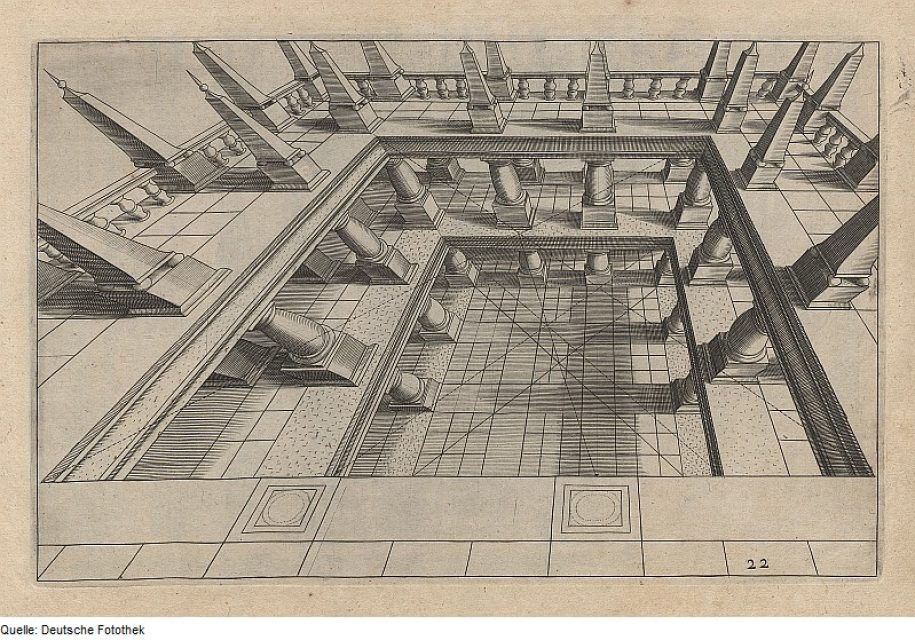
As soon as we tilt our gaze downward, though, parallel verticals start to converge towards their own vanishing point, which curiously lies directly below our feet, or, to be more exact, on the gravitational axis passing through the point from which we look.

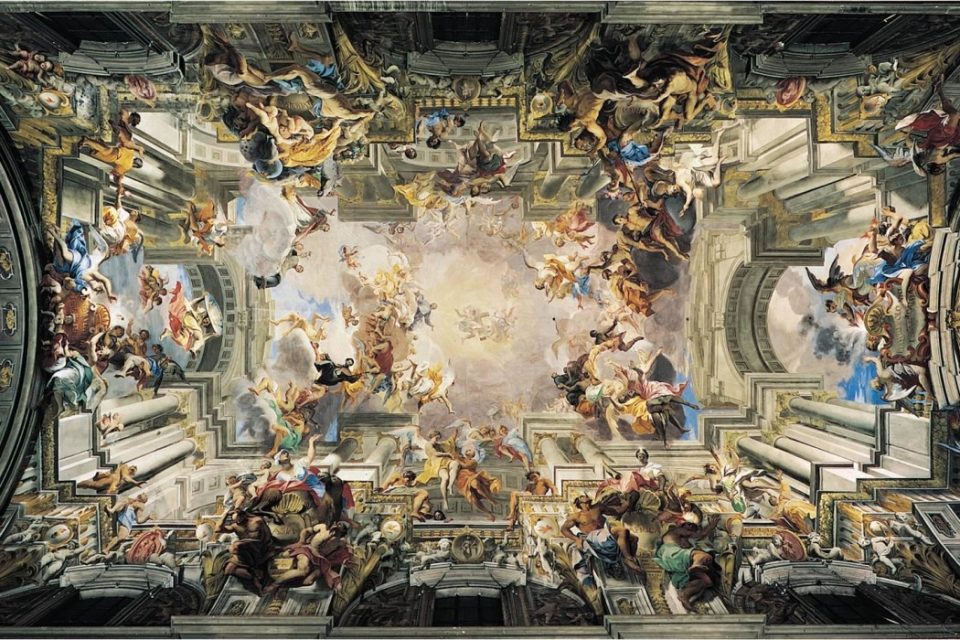
The effects of vertical convergence have been exploited in the opposite, upward direction, particularly in Renaissance and Baroque ceiling painting. There, such convergence visually opened up ceilings and created spectacular constructions. Painted architecture could appear to extend into the heavens above, populated by ascending bodies and soaring angels.

The modest downward inclination of our everyday looking, though, seems to have been largely disregarded. Of course, one could argue that a painting hanging vertically on a wall quite naturally invites the verticals within its image to remain parallel to its own vertical edges. But this reasoning never takes us very far from the notion of the painting as a window. A window, after all, invites us to look straight through it.

For a painter, this convention creates a number of practical problems. A level gaze tends to centre the field of vision on the horizon, while what interests us might lie predominantly below or above us. To accommodate this without tilting the viewpoint, large portions of the resulting image may have to be cropped to arrive at the desired composition. Furthermore, the neutral frontal viewpoint creates a certain division between the viewer and the image. The depicted world remains opposite us, rather than extending towards the space we ourselves occupy.

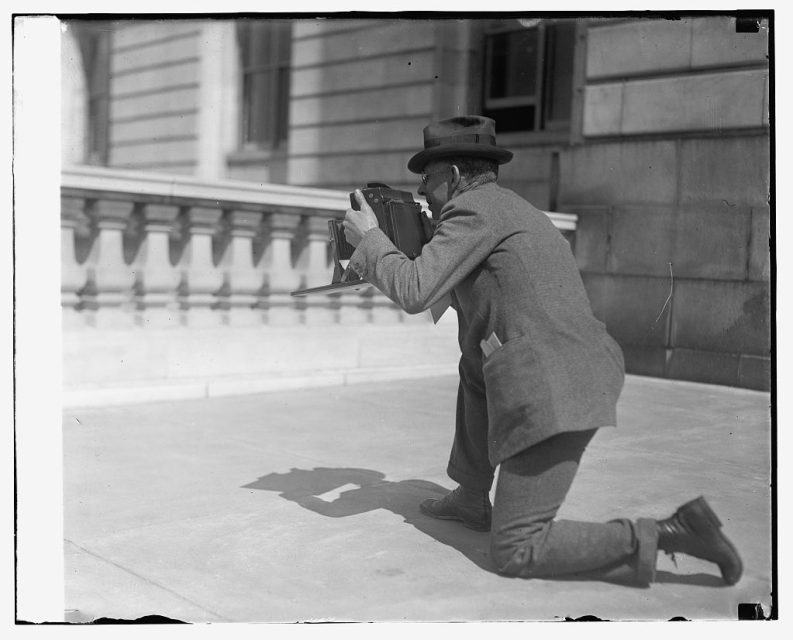
Photography, too, has traditionally gone to great lengths to evade the third vanishing point. The once familiar gesture of kneeling down to photograph a standing person is a simple example: lowering the camera closer to the middle of the figure allows the photographer to keep the viewing direction level and thus avoid vertical convergence and the resulting perspectival distortion of the figure. Shift lenses, view cameras and, more recently, digital perspective corrections provide more sophisticated solutions to the same problem.

While cameras were held to the eye and photographs composed through a viewfinder, the position of the camera remained closely tied to that of our own eyes. With smartphones, this connection has largely disappeared. We hold them freely in front of our bodies and simply tilt them towards whatever we want to photograph, making tilted perspectives much more common. We still tend to regard the resulting vertical convergence as a distortion, although it is simply the geometrical consequence of a downward-tilted camera and corresponds closely to the way we look at many of the things in front of us in the first place.

Perhaps we need to distinguish between our natural vision and natural-looking images. They are not the same thing. What we perceive as natural in an image depends little on the geometry of an actual act of looking. We are simply used to pictures behaving in certain ways.

A tilted perspective might offer something that a frontal one cannot achieve quite as easily. The place from which we look becomes physically perceptible. Our height above the ground begins to matter. It implies balance, footing and potentially falling.
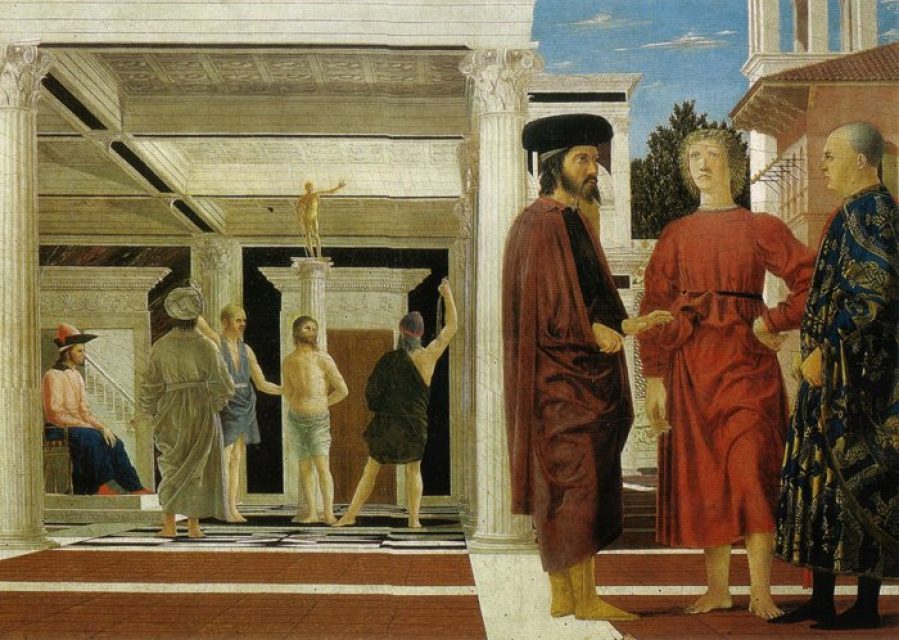
Piero della Francesca, The Flagellation of Christ, c. 1455–1460. Low viewpoint, with parallel verticals.
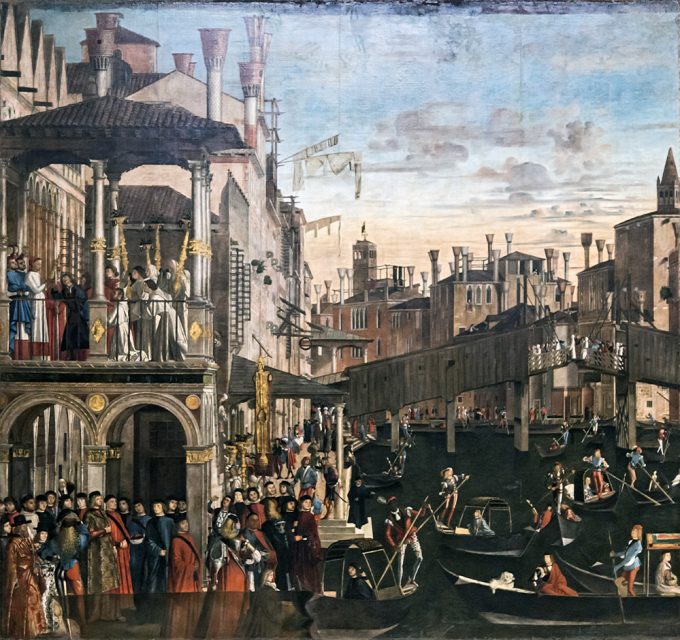
Vittore Carpaccio, The Miracle of the Relic of the True Cross at the Rialto Bridge, c. 1496. Elevated viewpoint, while the architectural verticals remain parallel.
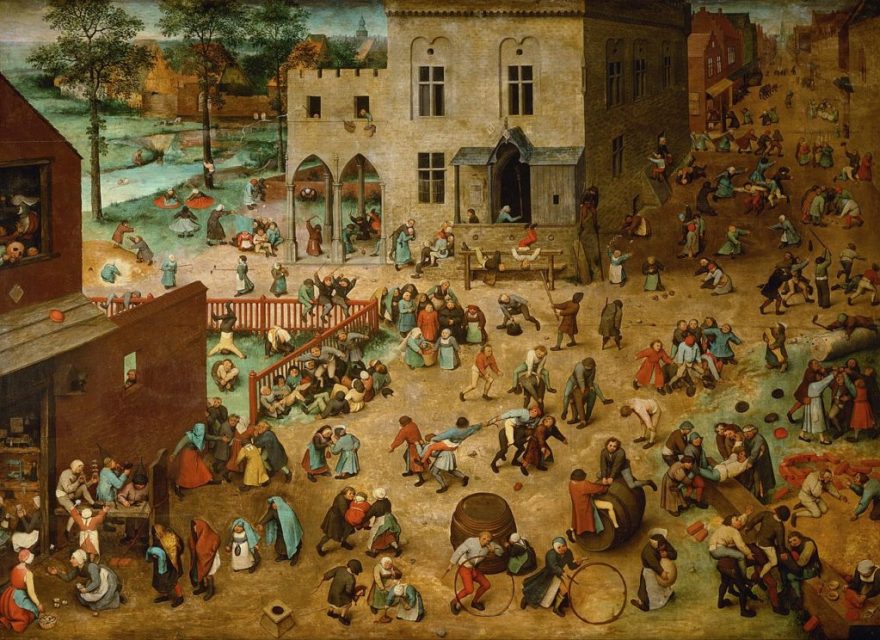
Pieter Bruegel the Elder, Children’s Games, 1560.
Hans Vredeman de Vries, Perspective, 1604–05. An early systematic construction of downward three-point perspective.
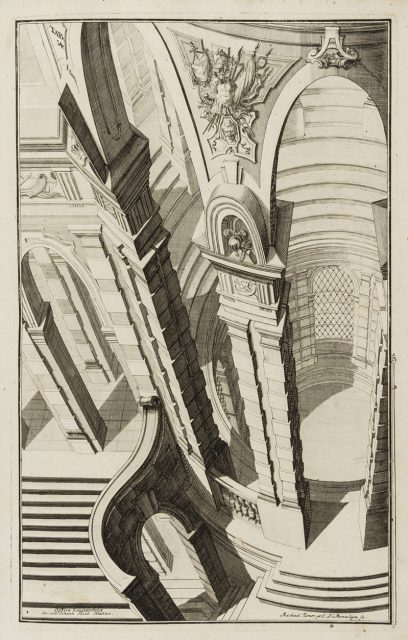
Johann Jacob Schübler, Perspectiva Pes Picturae, 1719–20. An elaborate demonstration of three-point perspective
Johann Jacob Schübler, Perspectiva Pes Picturae, 1719–20.
Andrea Pozzo, The Apotheosis of Saint Ignatius, 1685–94. The ceiling opens upward into an illusionistic continuation of the architecture.
Utagawa Kuniyoshi, nineteenth century. Japanese prints often assume a high vantage point, but resolve perspective in a different way.
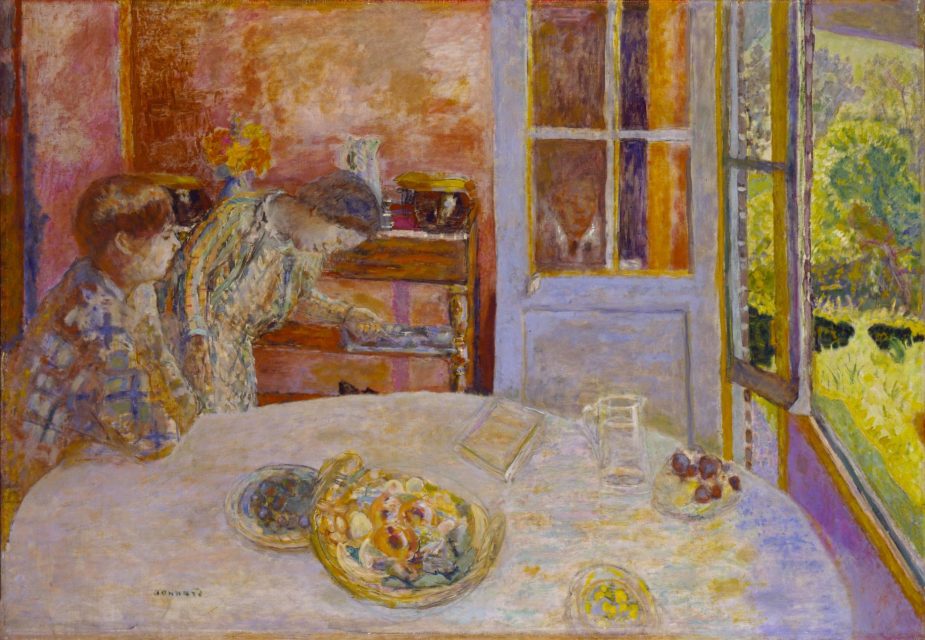
Pierre Bonnard, The Dining Room, Vernon, c. 1925. Bonnard often assumes a downward view, while mostly retaining parallel verticals.
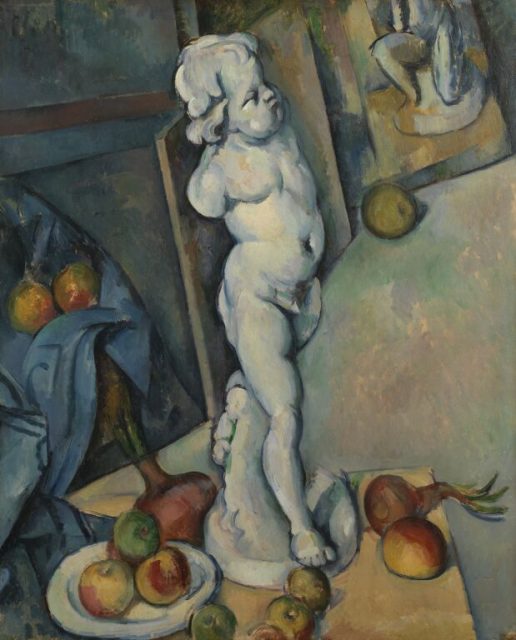
Paul Cézanne, Still Life with Plaster Cupid, c. 1895. Cézanne combines several downward viewpoints within a single image.
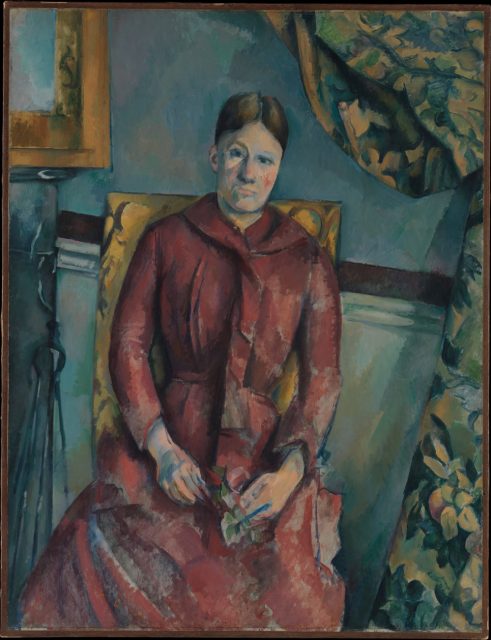
Sometimes converging verticals appear in Cézanne’s paintings. Paul Cézanne, Madame Cézanne in a Red Dress, 1888–90.
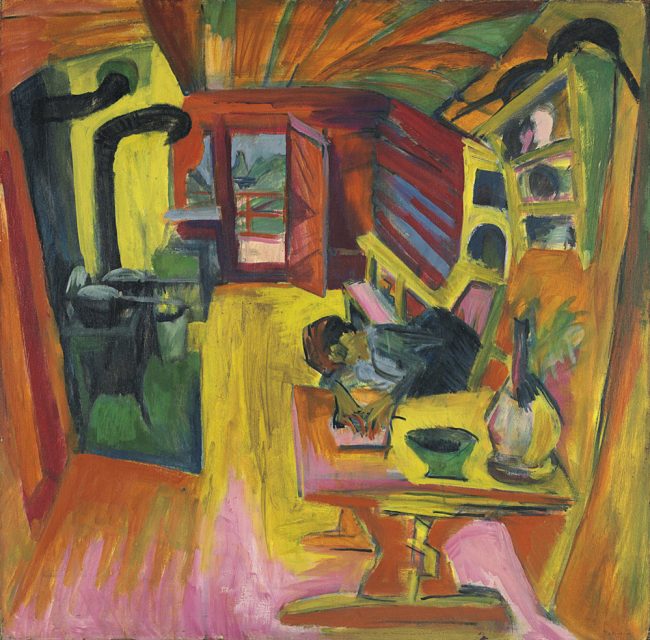
Kirchner pushes the downward view into a radically distorted space. Ernst Ludwig Kirchner, Alpine Kitchen, 1918.
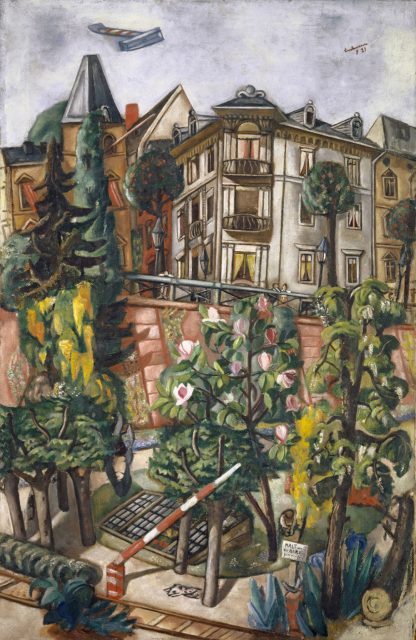
Beckmann sometimes uses radically converging verticals without adhering to a strict perspective. Max Beckmann, The Garden, 1921.
Keeping the camera level was one way of avoiding converging verticals. A. W. Leonard with a large-format camera, c. 1920s.
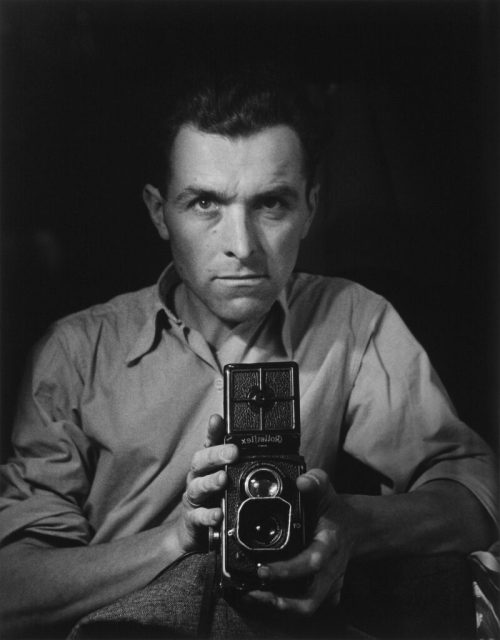
The waist-level viewfinder separates the camera from the photographer’s eye and allows a lower viewpoint. Robert Doisneau, Self-Portrait with Rolleiflex, 1947.
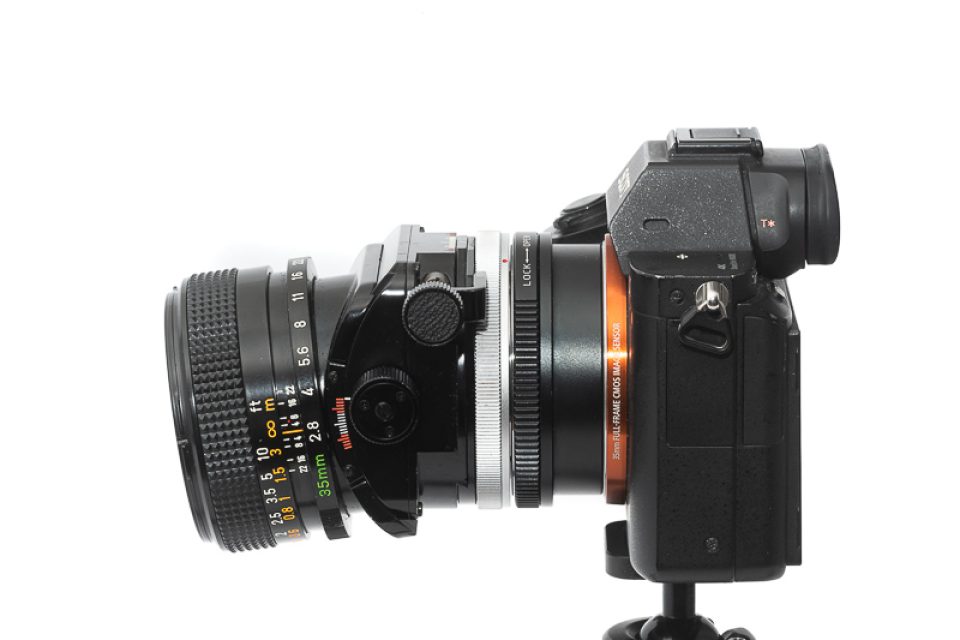
Shift lenses allow the camera to remain level while moving the field of view up or down. Canon TS 35mm f/2.8 S.S.C., introduced in 1973.
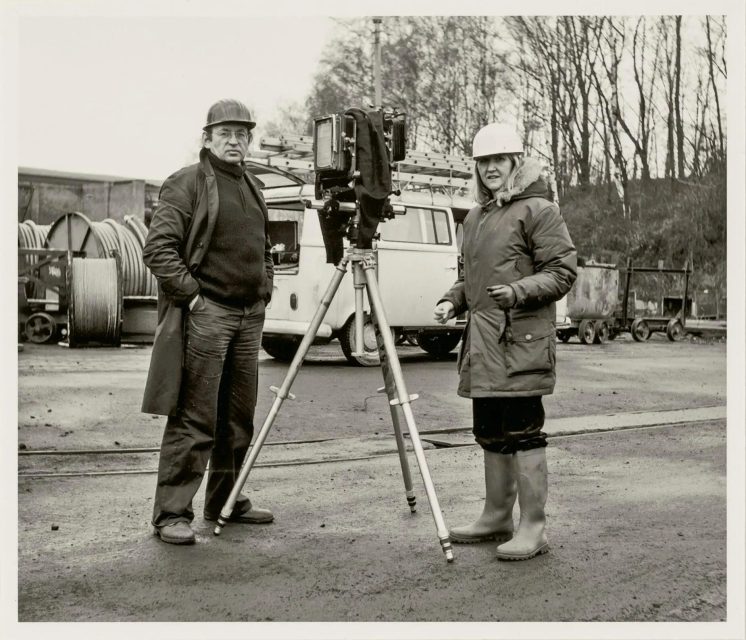
View cameras allow precise control of perspective through movements of the lens and film plane. Bernd and Hilla Becher with their large-format camera.
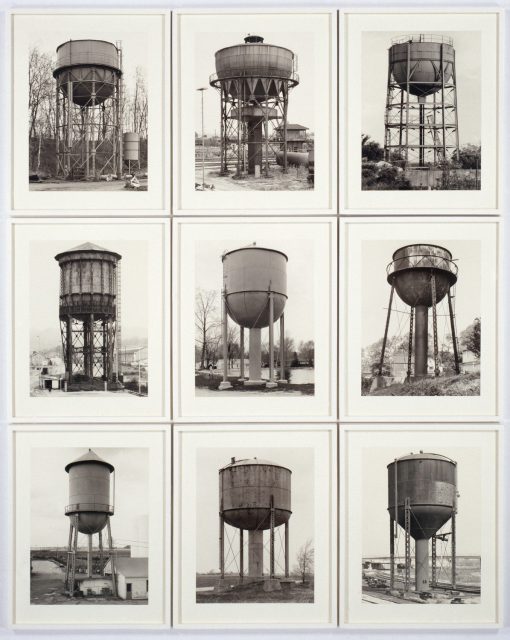
The Bechers systematically suppress converging verticals, reinforcing the frontal neutrality of their photographs. Bernd and Hilla Becher, Water Towers, 1960s–80s.
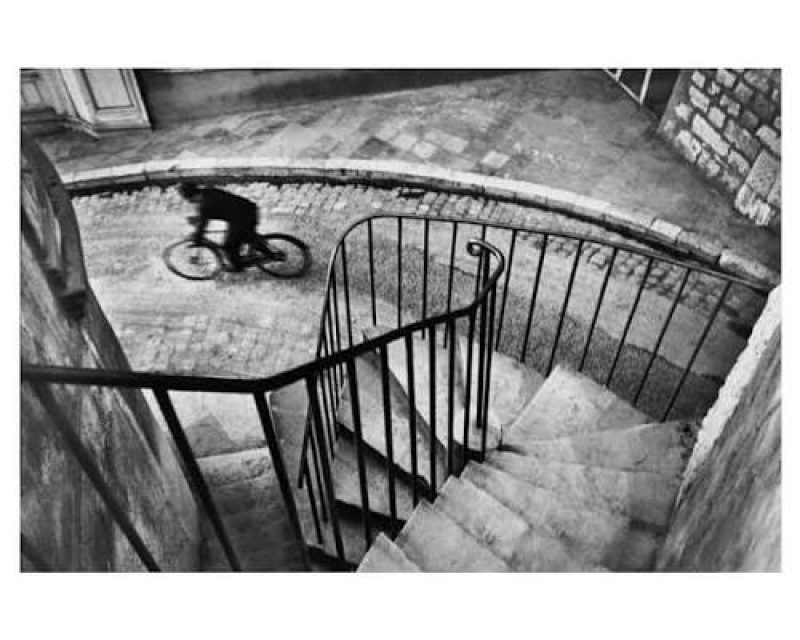
Other photographers, like Cartier-Bresson, embraced the tilted view and converging verticals, making their photographs feel more participative. Henri Cartier-Bresson, Hyères, France, 1932.
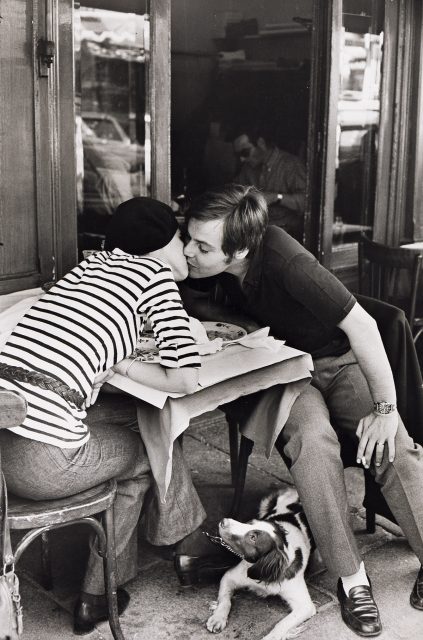
A tilted perspective does not need to be spectacular, but places us right into the scene. Henri Cartier-Bresson, Couple Kissing, Boulevard Diderot, Paris, 1968.
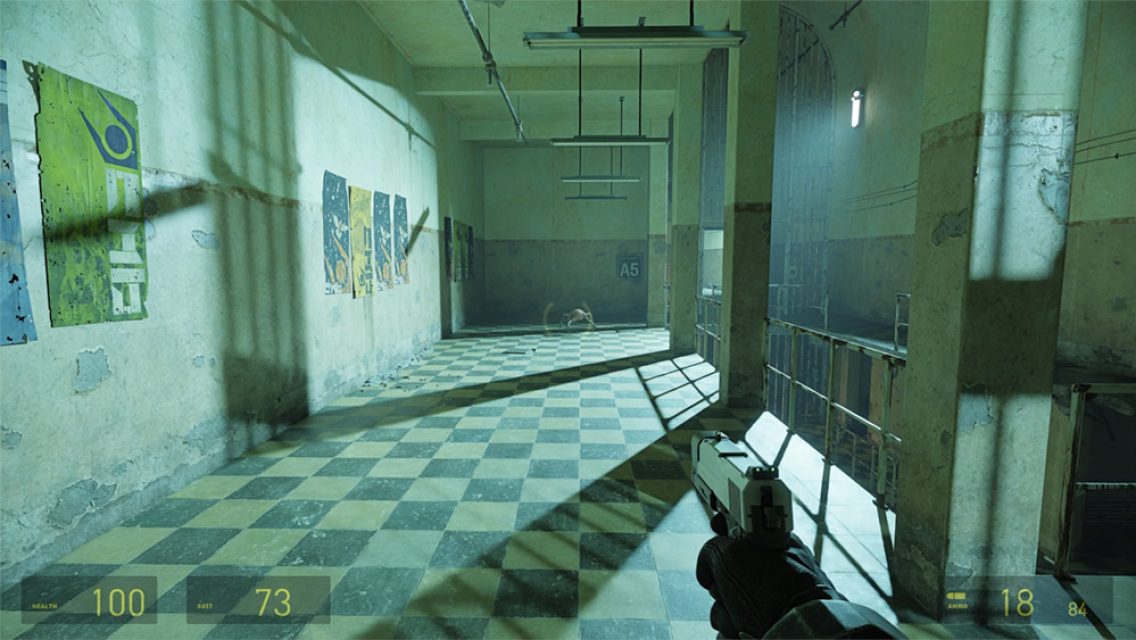
In computer games, tilted perspectives are omnipresent and feel entirely natural. Perhaps they will eventually seem just as natural in other images. Half-Life 2, 2004.
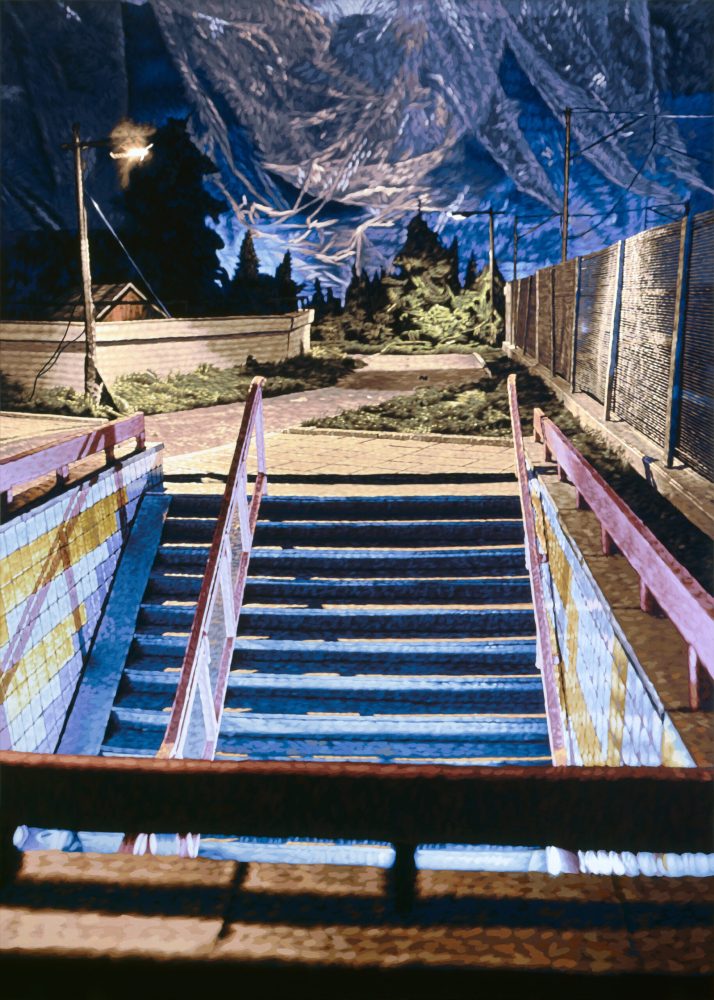
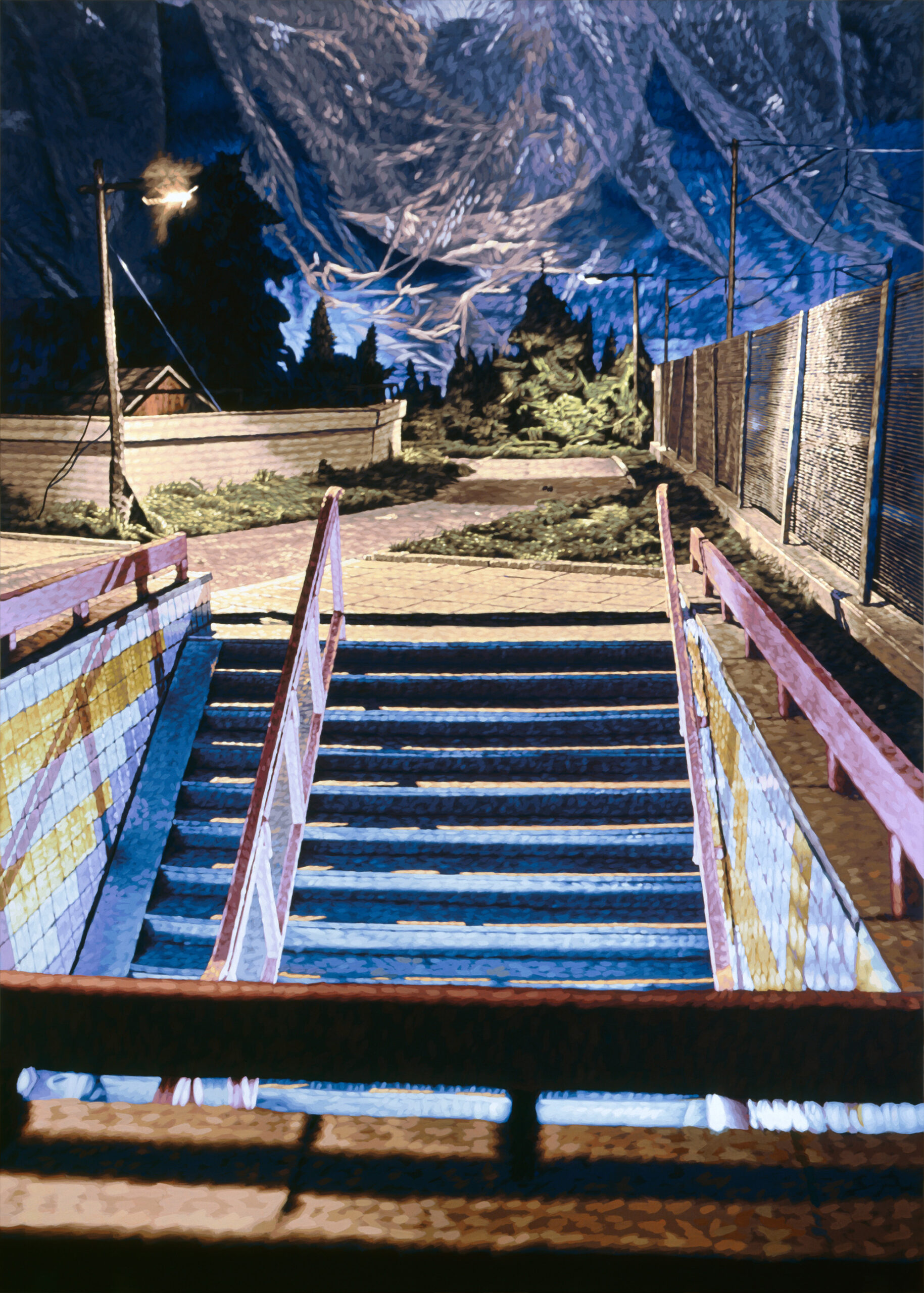
Philipp Fröhlich (115L), 2010, tempera on canvas, 245 x 175 cm
(115L), 2010, tempera on canvas, 245 x 175 cm

Sign up to receive a brief update every two weeks when a painting is added.