Birches and Magpies

Birch trees are my favourites. They are awkward and slender in growth, but their real attraction is their bark. In winter especially, when all the foliage has disappeared, the graphic black-and-white pattern of the trunks dissolving into sinuous branches and drooping twigs is both intricate and erratic.

In spring they have the most beautiful, fresh green leaves, which appear early and often look luminous against the light. With their arrival, all their wintry drama gives way to a rather juvenile appearance. In the Rhineland, young admirers traditionally place young birches, called Maibäume, decorated with colourful paper strips in front of their beloved’s window or door.

There is a Westphalian legend, according to which the final and decisive battle will take place under a birch tree, after which there will be everlasting peace.

It won’t be the birch tree in front of our house, because it was cut down three weeks ago. Before that, the only battles taking place there were between the magpies.

I feed them peanuts in my garden. They are very cautious and wait until the air is clear to make a small incision from the garden wall. They dive in and out as fast as they can, securing a peanut somewhere in a hidden stash before returning in the hope of catching another before the others take them all.

They are very elegant, with their elongated, diamond-shaped tails and iridescent blue-green plumage. It is strange that such a sophisticated-looking bird should have such a harsh, chattering voice. It does reflect their behaviour, though. While they are very sociable and often move around in groups, they constantly quarrel. A gathering of magpies is often called a parliament and they are even known to hold funerals when one of them dies.

There are many superstitions surrounding both birches and magpies. I particularly like the English nursery rhyme that predicts your future by the number of magpies you spot:

One for sorrow,

Two for joy,

Three for a girl,

Four for a boy,

Five for silver,

Six for gold,

Seven for a secret never to be told.

Jan Hackaert, An Avenue of Birches Beside a River, 17th century.
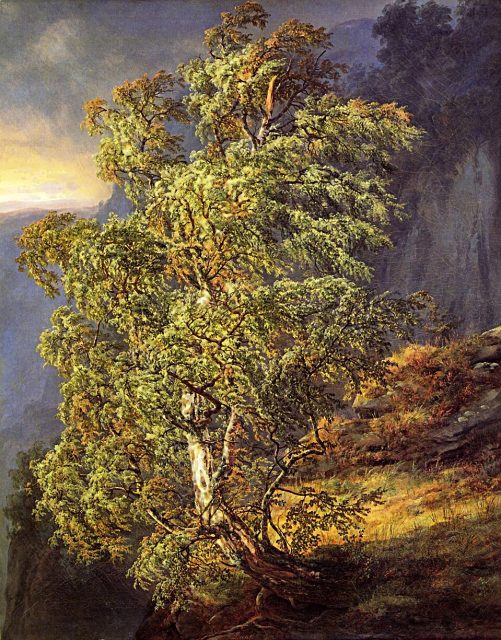
Johan Christian Dahl, Birch Tree in a Storm, 1849.
Edvard Munch, Birch Trees in the Autumn, 1882.
Edvard Munch painted quite a few birch trees. Birch Trees in the Autumn, 1882.
Isaac Levitan, Birch Grove, 1885–89.
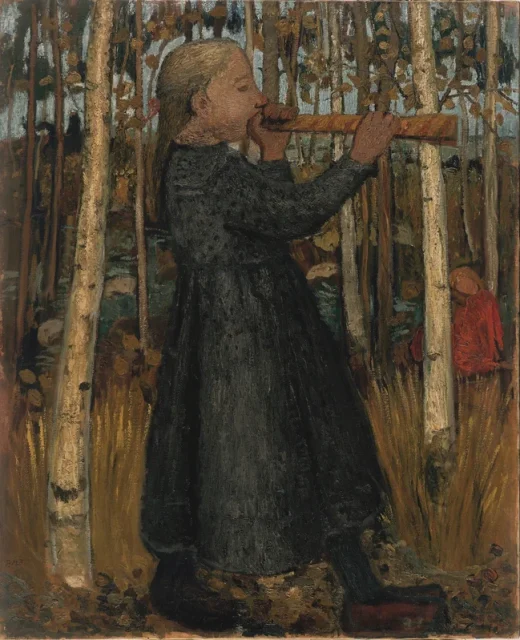
Worpswede being surrounded by marshland, Paula Modersohn-Becker painted lots of birches. Girl Blowing a Flute in the Birch Forest, 1905.
Piet Mondrian painted birch trees again and again in his early work. Small Birch Forest, c. 1902.
Klimt’s birch trees are probably the most famous. Birch Forest I, 1902.
Neil Welliver’s birches are almost unnaturally graphic. The Birches, 1977.
Alexei Korzukhin, The Hen Party, 1889. The bride’s path is swept with a birch broom as part of a traditional Russian pre-wedding ritual.
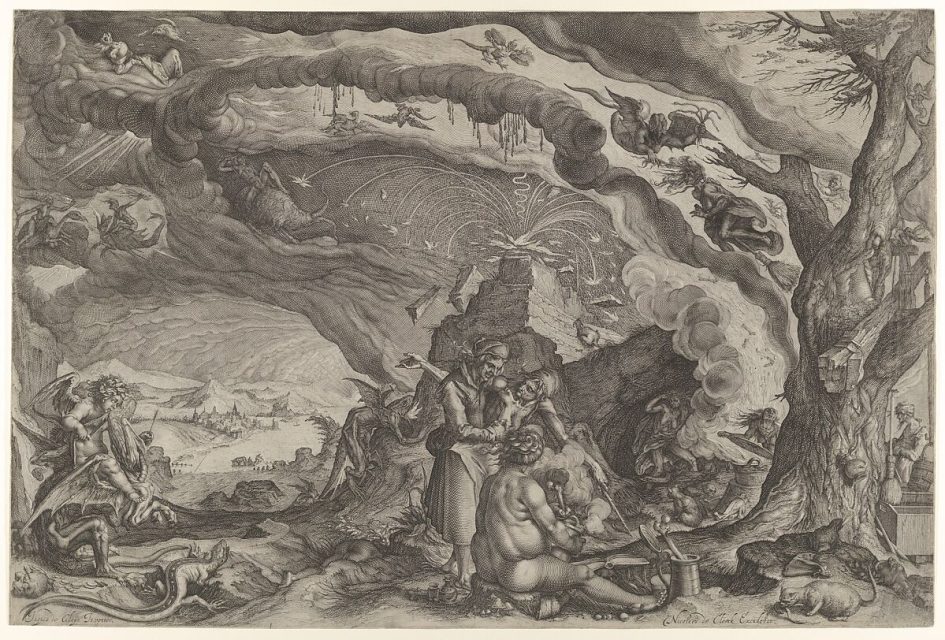
Witches also fly on broomsticks made of birch twigs. Andries Stock after Jacques de Gheyn II, Witches Preparing for Sabbath, c. 1610.
Birch brooms are still used by street sweepers today.
A decorated Maibaum in Cologne, placed outside the home of a beloved.
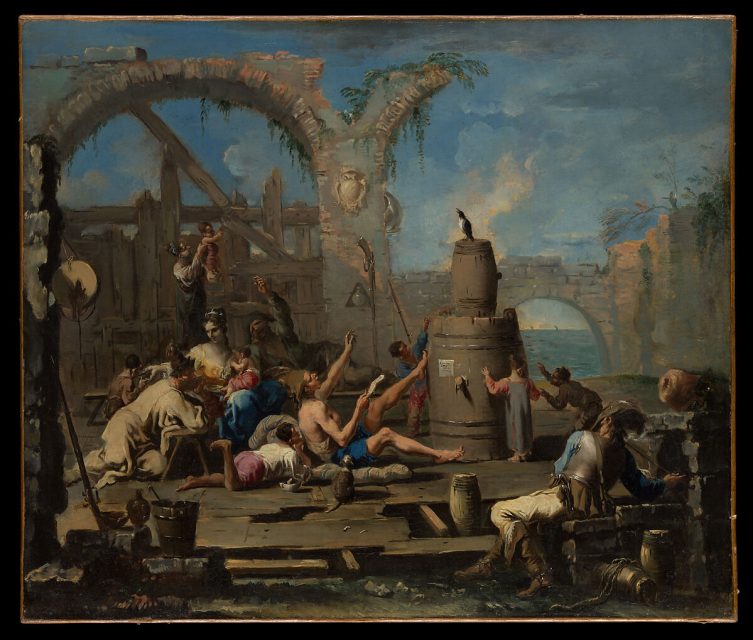
A man tries to teach a magpie to sing. Alessandro Magnasco, The Tame Magpie, c. 1707–08.
Melchior d’Hondecoeter, A Hunter’s Bag near a Tree Stump with a Magpie (The Contemplative Magpie), c. 1678.
Pieter Bruegel the Elder, The Magpie on the Gallows, 1568.
Claude Monet, The Magpie, 1868–69.
Qi Baishi, Magpies and Plum Blossoms, 20th century. In China, magpies are traditionally associated with happiness and good fortune.
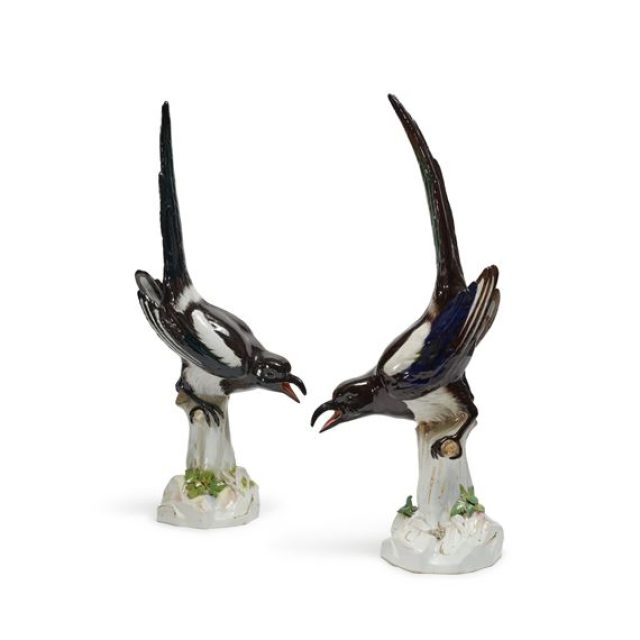
Johann Joachim Kändler, pair of Meissen magpies, c. 1740. Kändler originally modelled life-size magpies for Augustus the Strong’s Japanese Palace in Dresden in 1733.
A gathering of magpies around a dead companion, a behaviour sometimes referred to as a “magpie funeral”.
My mock-up for One for Sorrow, Two for Joy
My mock-up for One for Sorrow, Two for Joy.
Philipp Fröhlich's One for Sorrow, Two for Joy II (348L), 2022, oil on canvas, 245 x 175 cm
One for Sorrow, Two for Joy II (348L), 2022, oil on canvas, 245 x 175 cm

Sign up to receive a brief update every two weeks when a painting is added.