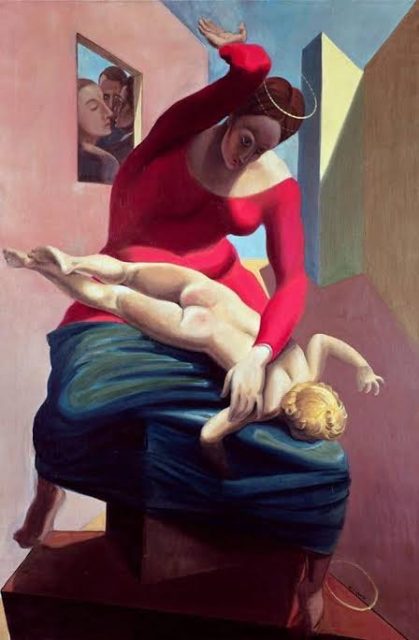
I must have been about four or five years old when a cleaning lady came to our house, probably once a week for some time. She had a little son who was about my age, and I remember him being very aggressive. Having been a rather skinny and frail child myself, physical confrontation was always out of the question. Somehow, though, I managed to calm him down and get along with him during his short weekly visits.
What I do remember very vividly, however, is his mother telling mine how the boy’s father would lock his son in a wardrobe as punishment.
And I can still remember wondering whether this was because the boy misbehaved so badly, or whether he might have been so aggressive precisely because his father locked him in the wardrobe. Or perhaps his father was just as aggressive as he was, but being bigger and stronger, could simply do as he pleased with his son.
There is an often-quoted biblical proverb saying “He that spareth his rod hateth his son: but he that loveth him chasteneth him betimes” (Proverbs 13:24).
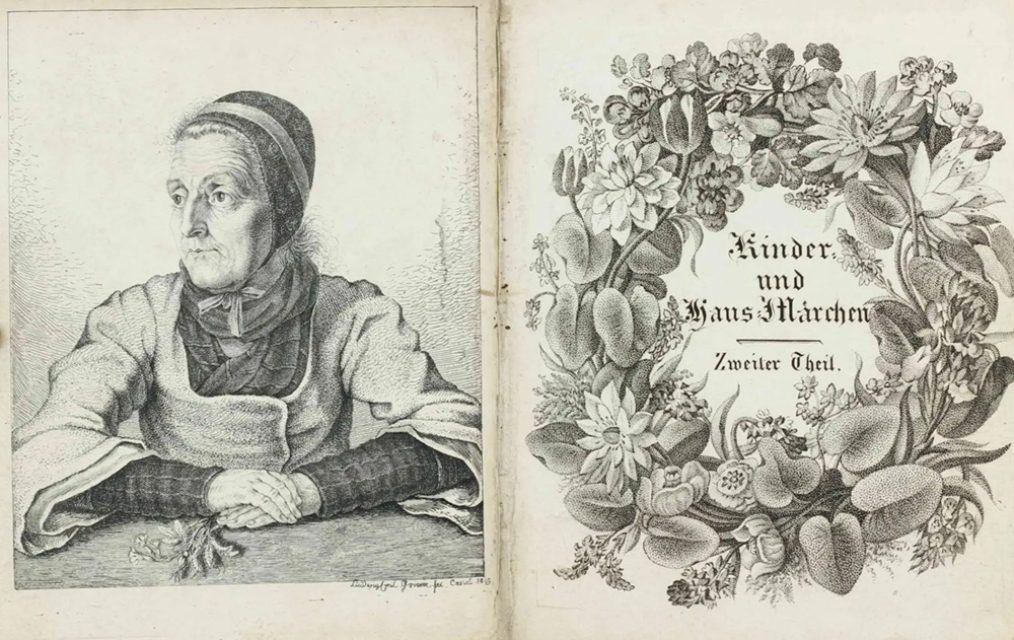
A rather literal illustration of this principle can be found in a short tale entitled The Wilful Child, included by the Brothers Grimm in their collection of fairy tales:
Once upon a time there was a wilful child who did not do what its mother wanted. For this reason, the dear Lord took no pleasure in the child and caused it to fall ill, and no doctor could help, and before long the child lay on its little deathbed.
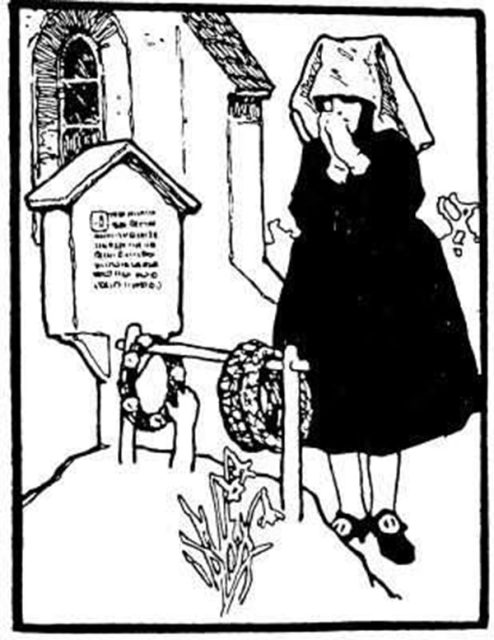
When the child had been lowered into the grave and the earth had been spread over it, suddenly its little arm emerged again and reached upwards. And whenever they put it back and covered it with fresh earth, it was no use, for the little arm kept coming out again.
Then the mother herself had to go to the grave and strike the little arm with a rod, and when she had done so, it withdrew, and only then did the child finally rest beneath the earth.
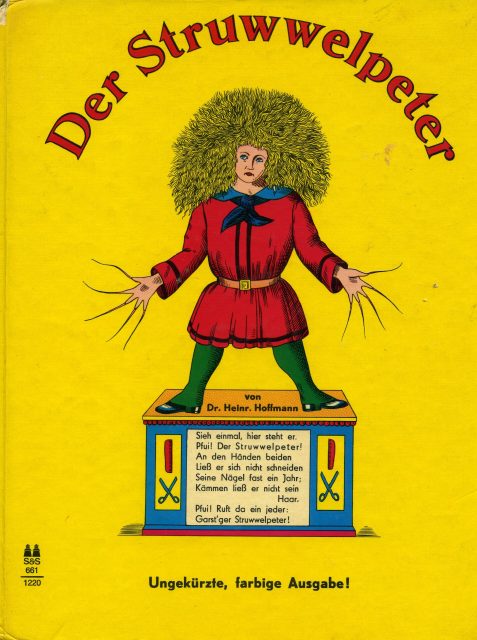
It’s curious, but we are never really told what the child has actually done, other than not doing what its mother wanted. The drastic consequences of its disobedience remind me of Heinrich Hoffmann’s Struwwelpeter.
Hoffmann, a physician, liberal and psychiatric reformer, had been looking for a picture book to give his three-year-old son as a Christmas present. Finding everything available unsatisfactory, he decided to write and illustrate one himself. It was published in 1845 and later became known as Der Struwwelpeter.
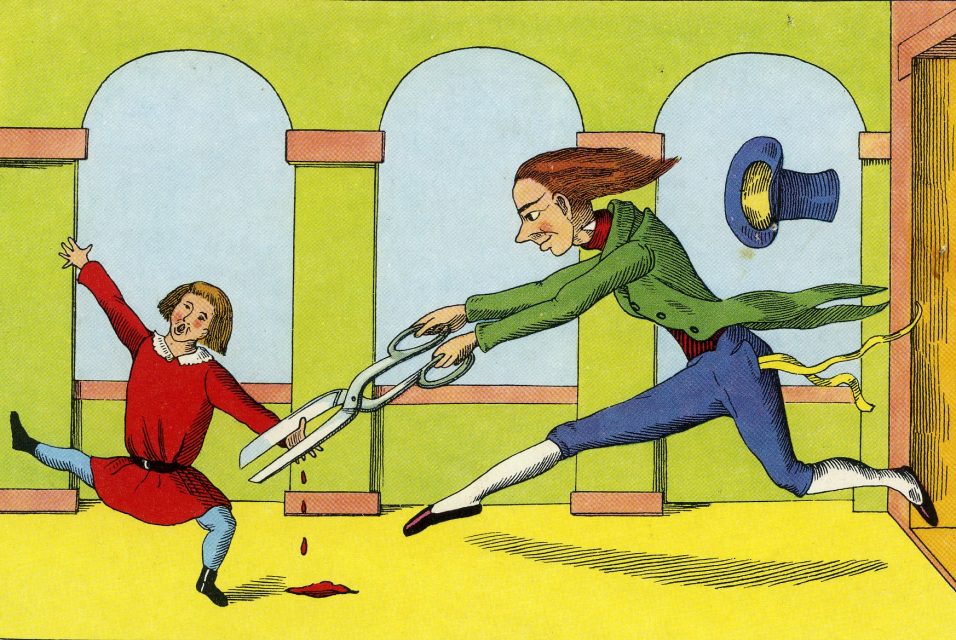
It features such grotesquely disproportionate consequences of undesirable behaviour as Konrad having his thumbs cut off by a tailor wielding an enormous pair of scissors because he refuses to stop sucking them.
Struwwelpeter left a lasting cultural impression in German-speaking countries.
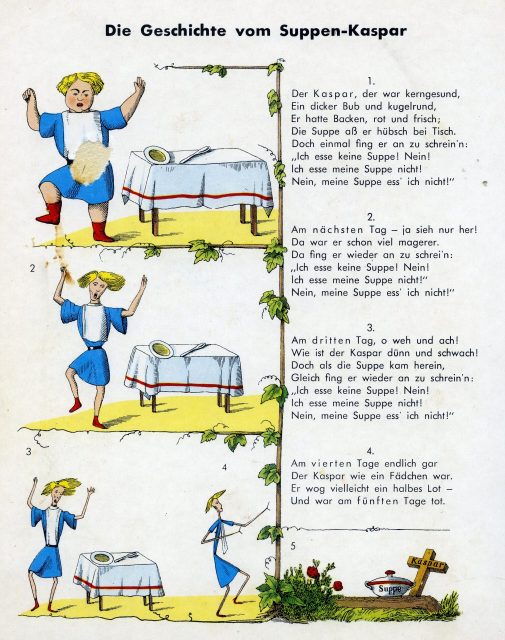
Having been a particularly poor eater in my early childhood, I was called Suppenkasper on numerous occasions by my parents. This Suppenkasper [Soup-Kaspar] repeats his catchphrase, “Nein, meine Suppe ess’ ich nicht!” [“No, I won’t eat my soup!”], in the course of three verses, with the accompanying illustrations showing the well-fed boy becoming ever thinner and stick-like. The fourth illustration shows only his grave, with a soup bowl on top.
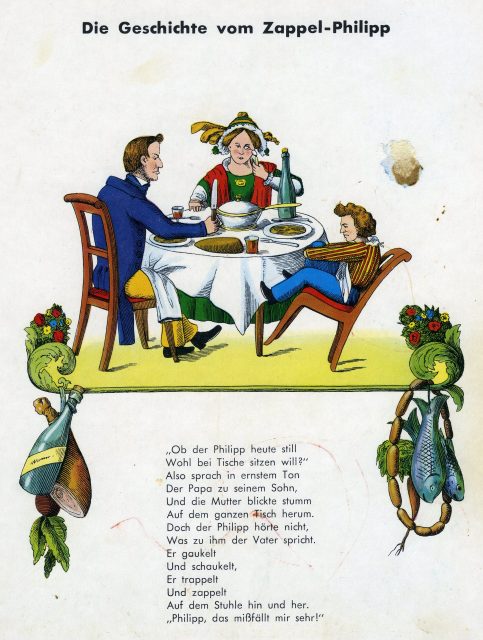
I was often called Zappel-Philipp [Fidgety Philip], too, since I share both the name and the restlessness of the boy who rocks back on his chair until he brings the entire contents of the dinner table crashing down on himself.
The ambiguity of these stories is that it is never entirely clear whether they are intended to frighten children into obedience or to make the whole business of punishment faintly ridiculous.
For a child actually being punished, however, I imagine the experience is very real indeed.